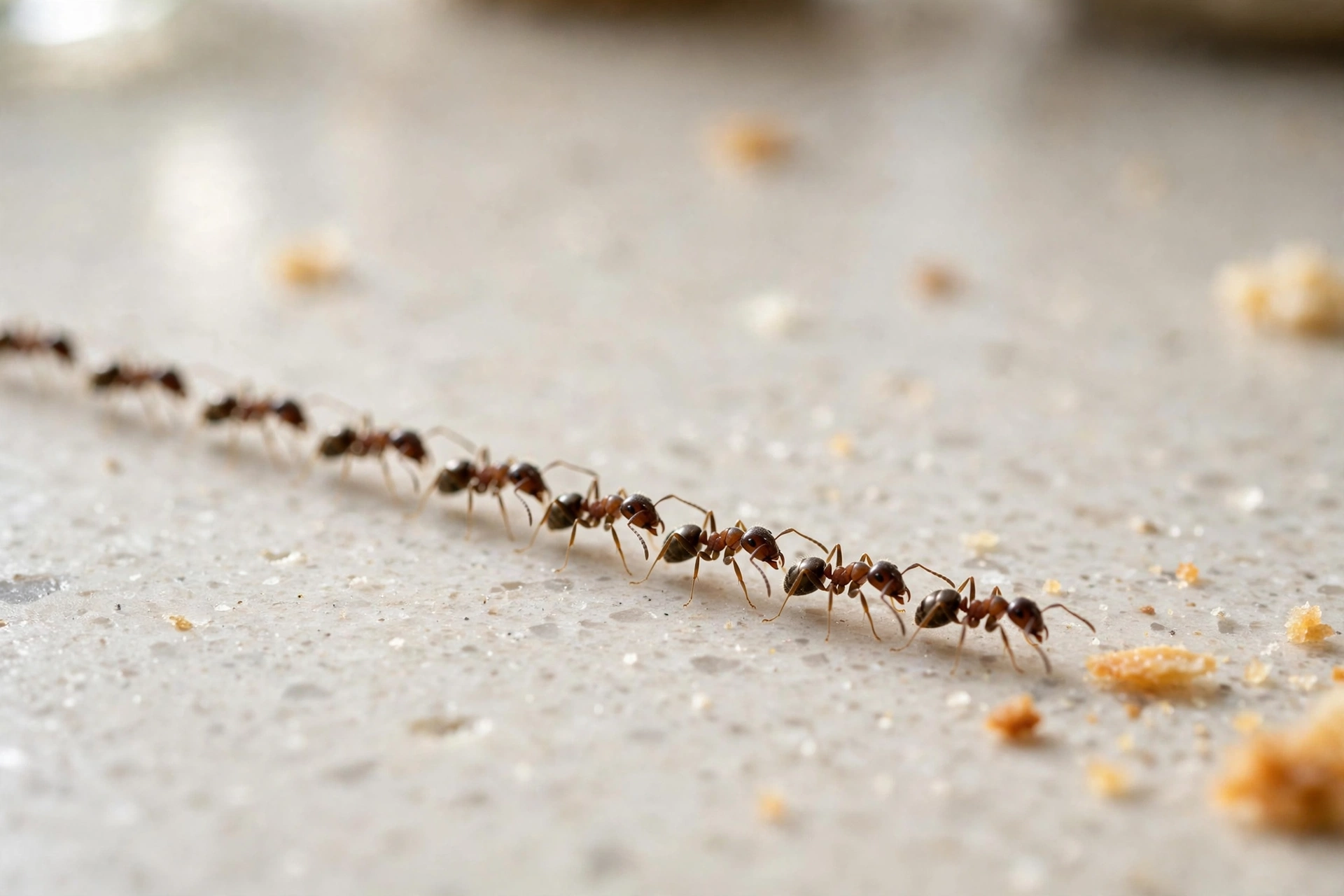
If you've got tiny brown ants marching across your kitchen counter in a perfect little highway, you're looking at Argentine ants — Southern California's most stubborn house ant. And here's what most people don't know: the ants in your kitchen and the ants in your neighbor's yard are part of the same colony. Argentine ants form massive supercolonies — one stretches across much of coastal California — with multiple queens in every nest. That's exactly why they're so hard to eliminate, and why the spray can under your sink usually makes the problem worse.
Here's what actually works.
Why spray makes Argentine ants worse
Most over-the-counter sprays are repellents. When you spray a trail, you don't kill the colony — you scatter it. Argentine ant colonies react to repellent sprays by "budding": queens and workers split off and form new colonies in your walls. One trail becomes three. This is the single biggest reason DIY ant control fails in SoCal, and it's why everything below avoids repellent sprays entirely.
7 steps that actually keep them out
1. Cut off the food supply
Argentine ants are sugar and grease fiends. Wipe down counters and stovetops daily, store cereal, sugar, and pet treats in sealed containers, take trash out nightly, and don't leave pet food sitting out — a bowl of kibble left overnight is an all-night ant buffet. Fix leaky faucets and dry out sinks before bed; they're after water just as much as food.
2. Fix moisture problems
In our climate, water is often the real attractant. Check under sinks, behind the washing machine, and around the water heater for slow leaks. Outside, adjust sprinklers so they don't blast the foundation, and pull mulch and soil back a few inches from the house wall — damp mulch against stucco is prime nesting habitat.
3. Seal their entry points
Ants get in through gaps you'd never notice. Caulk cracks around windows and doors, add or replace worn weatherstripping, seal where pipes and wires enter the house, and make sure window screens fit tight. You won't make a home airtight, but every sealed gap forces them into the open — where baiting works.
4. Cut their highways
Argentine ants travel along branches, vines, and shrubs touching your house like freeways. Trim everything back so nothing touches the roof, walls, or eaves — aim for at least a foot of clearance. Keep firewood and lumber stacked off the ground and away from the house.
5. Switch from sprays to baits
This is the step that matters most. Slow-acting ant baits (the gel or liquid kind) get carried back to the nest and shared — including with the queens. Place bait stations on the active trails indoors and along the foundation outside. Don't disturb the trail while baiting; you want maximum traffic carrying bait home. Expect activity to spike for a day or two, then collapse over 1–2 weeks.
6. Treat the perimeter, not just the kitchen
Killing the ants you see is cosmetic. The colony lives outside — in soil, under pavers, in wall voids. Place bait stations every 10–15 feet along the foundation where you see trailing, and refresh them until activity stops. If trails keep reappearing in new spots, the colony is budding and the strategy needs adjusting.
7. Know when it's a pro job
Call a professional if: trails keep returning after 2–3 weeks of baiting, ants are coming from inside wall voids or under the slab, or you're seeing them in multiple rooms (that usually means multiple nest sites). A technician can identify the nest locations and apply non-repellent treatments that the colony can't detect and bud away from.
When to call Fly Guys
If you've baited, sealed, and trimmed and they're still marching in, the colony has likely nested in your walls — and that's a job for targeted professional treatment. Fly Guys handles ant control across Rancho Cucamonga, the Inland Empire, and all of Southern California, with same-day service available. Call (909) 736-4750 or request a free inspection — we'll find the nest and end the highway for good.
Argentine ant FAQ
Why do Argentine ants keep coming back after I spray? Because repellent sprays cause the colony to "bud" — queens split off and start new colonies nearby. You haven't killed the colony; you've multiplied it. Slow-acting baits work because foraging ants carry them back to the queens.
Do Argentine ants bite? Are they dangerous? They don't bite or sting people, and they don't spread disease the way cockroaches do. The damage is contamination — they crawl through who-knows-what outside, then across your food prep surfaces. They're a sanitation pest, not a health emergency, but nobody wants them in the pantry.
Where are the ants coming from? How do I find the nest? Follow the trail. Argentine ants travel in defined highways — watch where the line goes at dusk or early morning when activity peaks. Outdoors, nests are shallow: under pavers, in mulch, along foundation edges, under debris. Indoors, wall voids and under appliances are common. If the trail disappears into a wall, the nest is likely inside the structure.
How fast can an exterminator get rid of Argentine ants? With professional baiting and non-repellent perimeter treatment, most homes see activity collapse within 1–2 weeks. Severe or wall-nested infestations can take a follow-up visit. Fly Guys offers same-day service — call (909) 736-4750.