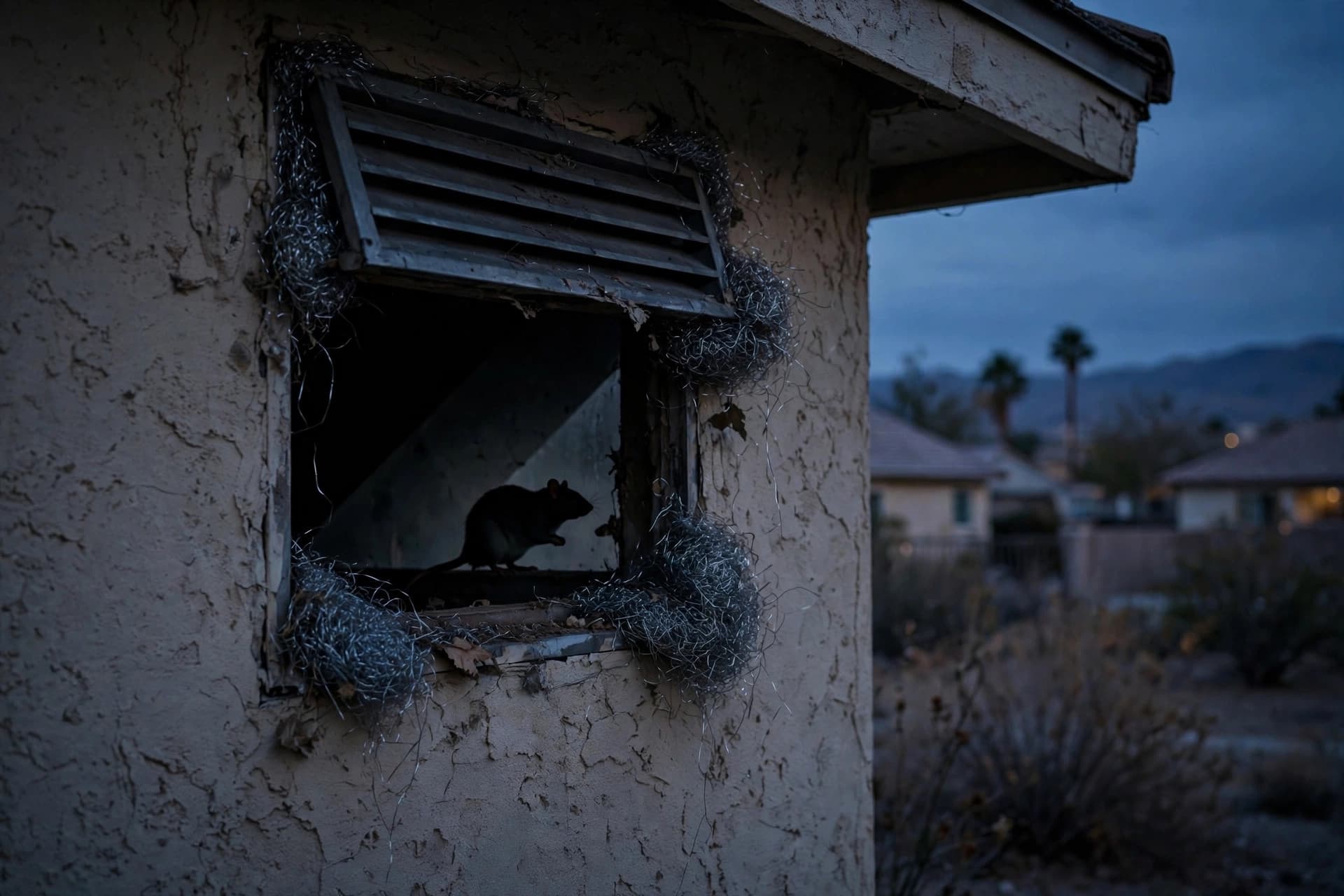
Hear scratching in the attic at night? You're not imagining it — and you're not alone. As nighttime temperatures drop across the Inland Empire, roof rats and mice start looking for warm shelter, and your attic is at the top of the list.
Fall is rodent season in Southern California. Here's how to know if they've moved in, and the exclusion steps that actually keep them out.
Why fall is the trigger
Roof rats — the most common rat in Inland Empire neighborhoods — are excellent climbers that live in trees, ivy, and dense landscaping all summer. When nights cool down and natural food gets scarce, they follow warmth and scent trails into attics, wall voids, and garages. Once one finds a way in, pheromone trails invite the rest.
Mice follow the same pattern at ground level, squeezing through gaps you'd swear were too small. (A mouse needs only a quarter-inch opening — about the width of a pencil.)
7 signs rodents have moved in
- Scratching or scurrying at night, especially in the attic or walls between 10pm and 4am
- Droppings — roof rat droppings are about half an inch with pointed ends; mouse droppings are smaller, like grains of rice
- Gnaw marks on wood, wiring, or stored items (rodents gnaw constantly to wear down their teeth)
- Nests made of shredded insulation, paper, or fabric in undisturbed corners
- Greasy rub marks along baseboards, pipes, or rafters where rodents travel the same routes
- Tracks or tail marks in dusty attic areas
- A musky or ammonia-like odor, especially in enclosed spaces
Exclusion: the fix that lasts
Here's what most homeowners get wrong about rodents: trapping removes the current tenants, but it does nothing about the open door. Exclusion — finding and sealing every entry point — is what stops the cycle. A good rodent job is part detective work, part construction.
Seal the entries
- Inspect the roofline, eaves, vents, and where utilities enter the house. Rats need only a half-inch gap.
- Cover attic and crawlspace vents with 1/4-inch hardware cloth (not chicken wire — rats chew through it).
- Seal gaps around pipes, conduits, and AC lines with steel wool plus caulk or expanding foam.
- Check garage door seals and weatherstripping — a worn bottom seal is a mouse highway.
Cut off the climbing routes
- Trim tree branches and shrubs at least 6 feet from the roofline. Roof rats cross from branches to eaves effortlessly.
- Thin out dense ivy and ground cover near the foundation — it's prime rat harborage.
- Keep firewood and debris piles away from the house.
Remove the food and water
- Secure trash cans with locking lids; don't leave pet food out overnight.
- Pick up fallen fruit from citrus and other trees promptly — it's a major roof rat attractant in SoCal.
- Fix dripping outdoor faucets and eliminate standing water.
Don't skip the attic inspection
Insulation damage, chewed wiring (a fire risk), and contaminated insulation are common in established infestations. A professional inspection maps the entry points you can't see from the ground and assesses whether cleanup or insulation replacement is warranted.
Why not just set traps or poison?
Traps catch individuals; they don't close entries, so new rodents keep arriving. Poison has its own problems: rodents often die inside walls (with the smell that follows), and secondary poisoning is a real risk to pets, owls, and other wildlife — California has restricted second-generation anticoagulant rodenticides for exactly this reason. Exclusion plus targeted trapping is the approach that ends the problem instead of managing it indefinitely.
Get a rodent inspection before they settle in for winter
The longer rodents are in the attic, the more damage they do to insulation and wiring — and the larger the colony grows. A fall inspection catches the problem early, when exclusion is straightforward.
Fly Guys Pest Control handles the exclusion work that stops re-entry — ask about trapping and re-treatment options when you call.
Call (909) 736-4750 to schedule service across the Inland Empire and Southern California, or request a rodent inspection.
FAQ
How do rats get into my attic?
Roof rats are strong climbers — they cross from tree branches to the roof, then enter through gaps in eaves, vents, or where utilities penetrate the roof. They need only a half-inch opening.
Are roof rats common in the Inland Empire?
Yes. Roof rats thrive in Southern California's suburbs, living in citrus trees, ivy, and attics. They're the most common rat species in Inland Empire residential neighborhoods.
Will rats leave on their own when it warms up?
No. Once established with food, water, and shelter, a colony stays and breeds year-round. Fall entry becomes a permanent infestation without intervention.
How much does rodent exclusion cost?
It depends on the size of the home, the number of entry points, and whether attic cleanup is needed. An inspection gives you an exact number — and exclusion is a one-time investment versus paying for trapping over and over.
Is rodent poison safe around pets?
Poison carries real risks — rodents can die in walls, and secondary poisoning threatens pets and wildlife. That's why we lead with exclusion and targeted trapping rather than broadcast baiting.