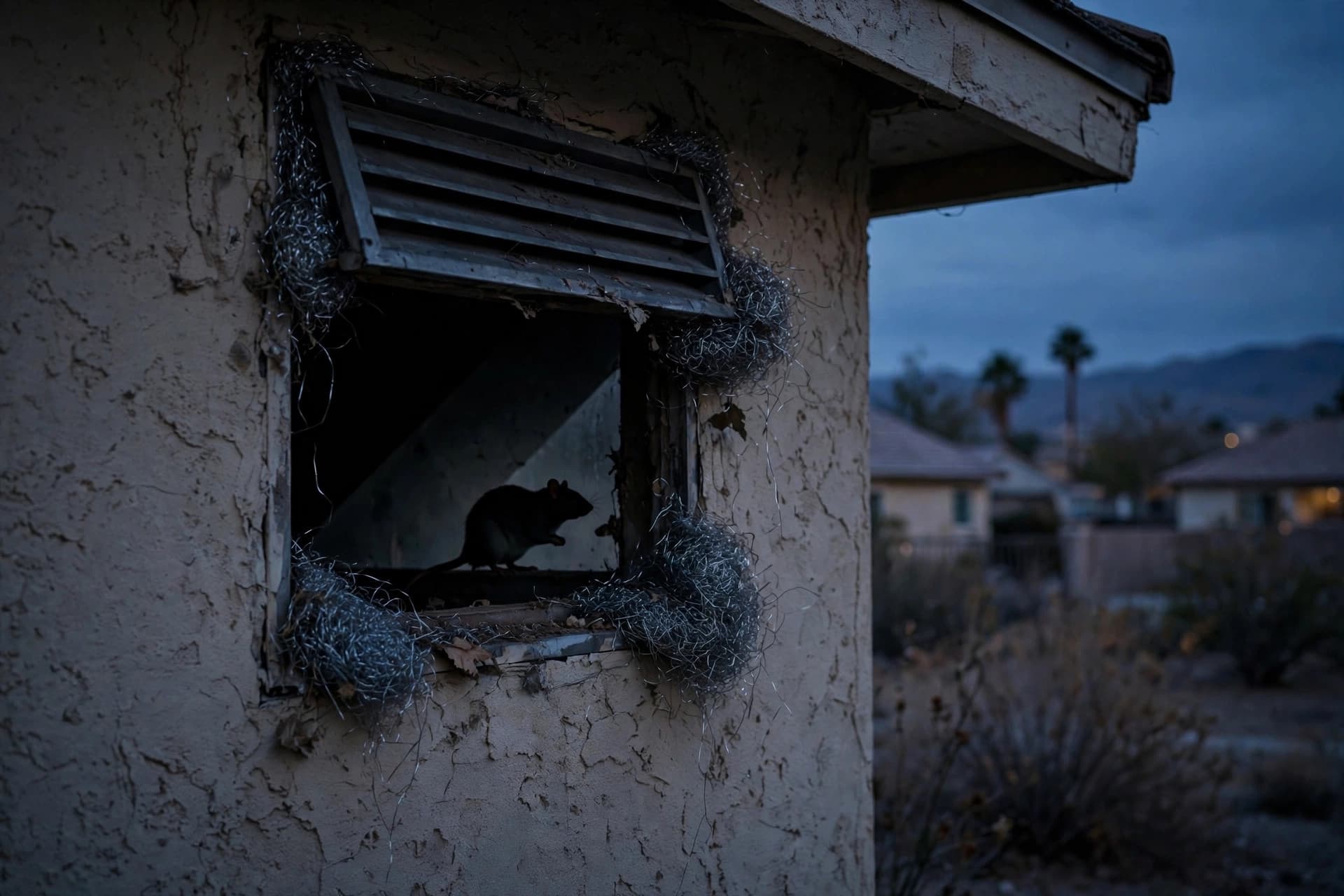
People in colder parts of the country get a winter break from pests. We do not. Inland Empire winters are mild, wet in bursts, and cold enough at night that anything living outside starts looking for a way in. The pests change, but the pressure does not.
Here is what we deal with from November through February, and what you can do about each one this week.
1. Rats and mice are moving in
This is the big one. Roof rats are everywhere in the Inland Empire, they love citrus and avocado trees, and when nights drop into the 40s they head for attics, garages, and wall voids. You will hear them before you see them: scratching or running sounds in the ceiling after dark. We explain the fall move indoors in Rats Are Moving Indoors for Fall.
Do this: walk the outside of the house and look for any gap a quarter-inch wide or larger — mice can squeeze through even smaller openings. Common ones are where the stucco meets the roofline, around the AC line into the wall, and at attic vents with torn screens. Trim tree branches back at least four feet from the roof. Pick up fallen fruit.
Call us if: you hear anything in the attic, find droppings in the garage, or see chew marks on anything. Trapping removes the animals already in, and sealing the entry points is what stops the next ones — trapping without sealing just makes room for the next ones. Rodent control and exclusion covers both.
2. Ants after the first rain
Argentine ants live in enormous colonies in the soil, and the first real rain floods them out. The next morning there is a line of them running along your kitchen counter. This happens every year, in every city from Pomona to Rancho Cucamonga.
Do this: wipe down counters, fix any dripping faucet, and store pet food in a sealed container. Do not spray the trail with a store-bought can. It kills the ants you can see and splits the colony into several new ones.
Call us if: they are back within a day or two of cleaning up, or you are seeing them in more than one room. We have a full post on Argentine ants if you want the details.
3. Black widows in the garage
Winter is when people find black widows, because winter is when people go into the garage to get the holiday decorations. They like undisturbed boxes, the gap behind the water heater, meter boxes, and the underside of patio furniture that has been stacked for the season. A black widow is shiny black, with a red hourglass mark underneath — do not lean in close or reach in by hand to check.
Do this: wear gloves when you pull out stored boxes. Shake out anything that has been sitting. Keep storage off the floor if you can.
Call us if: you find more than one, or you have kids or pets using the garage. Spider control is a perimeter treatment plus knocking down the webs and egg sacs, and it is quick.
4. The firewood pile
If you burn wood, the stack is a hotel. Termites, carpenter ants, spiders, and the occasional rat all like it. Stacked against the house, it is a bridge straight to your framing.
Do this: store it off the ground and at least ten feet from the house. Bring in only what you will burn that day.
5. Pantry pests and the holiday baking
Indian meal moths and flour beetles ride in with bulk flour, nuts, dried fruit, and birdseed, and the holidays are when all of that comes into the house at once.
Do this: check the pantry for small moths, webbing in the corners of packages, or tiny beetles in flour. Throw out anything infested in an outdoor bin. Move dry goods into sealed containers.
6. Gophers do not stop
Gophers stay active all winter in Inland Empire lawns, and wet soil makes digging easier. Fresh fan-shaped mounds and soft spots in the yard are the sign. Gopher and mole control is a trapping program, and winter is a good time to start it before spring growth hides the activity.
7. Termites are quieter, not gone
Termite swarms are a spring and late-summer thing, so winter feels safe. Subterranean colonies are still feeding, and winter rain softens the soil around your foundation. Winter is a good time to get a termite inspection because colonies are still active and any treatment can be scheduled before swarm season. Inspections are free.
8. Check the garage door seal
The rubber strip at the bottom of the garage door is one of the most common rodent entry points we find. If you can see daylight under it, so can a mouse.
Do this: replace the seal. It is a hardware-store item and takes twenty minutes.
The short version
Seal the gaps, trim the trees, store food and firewood properly, and look in the attic once. If something is already inside, call. Fly Guys serves Rancho Cucamonga and the entire Inland Empire, and we tell you what we find before we tell you what it costs.
For a free inspection, call (909) 736-4750.